
Three serious VoIP phone vulnerabilities have landed in 2026, and the latest one arrived with July’s Patch Tuesday. For service providers the lesson is consistent: customers won’t patch desk phones, so the protection has to live in your provisioning system and network design. Firmware baselines, locked down web interfaces and voice VLANs stop most of these attacks cold.
The 2026 Scorecard So Far
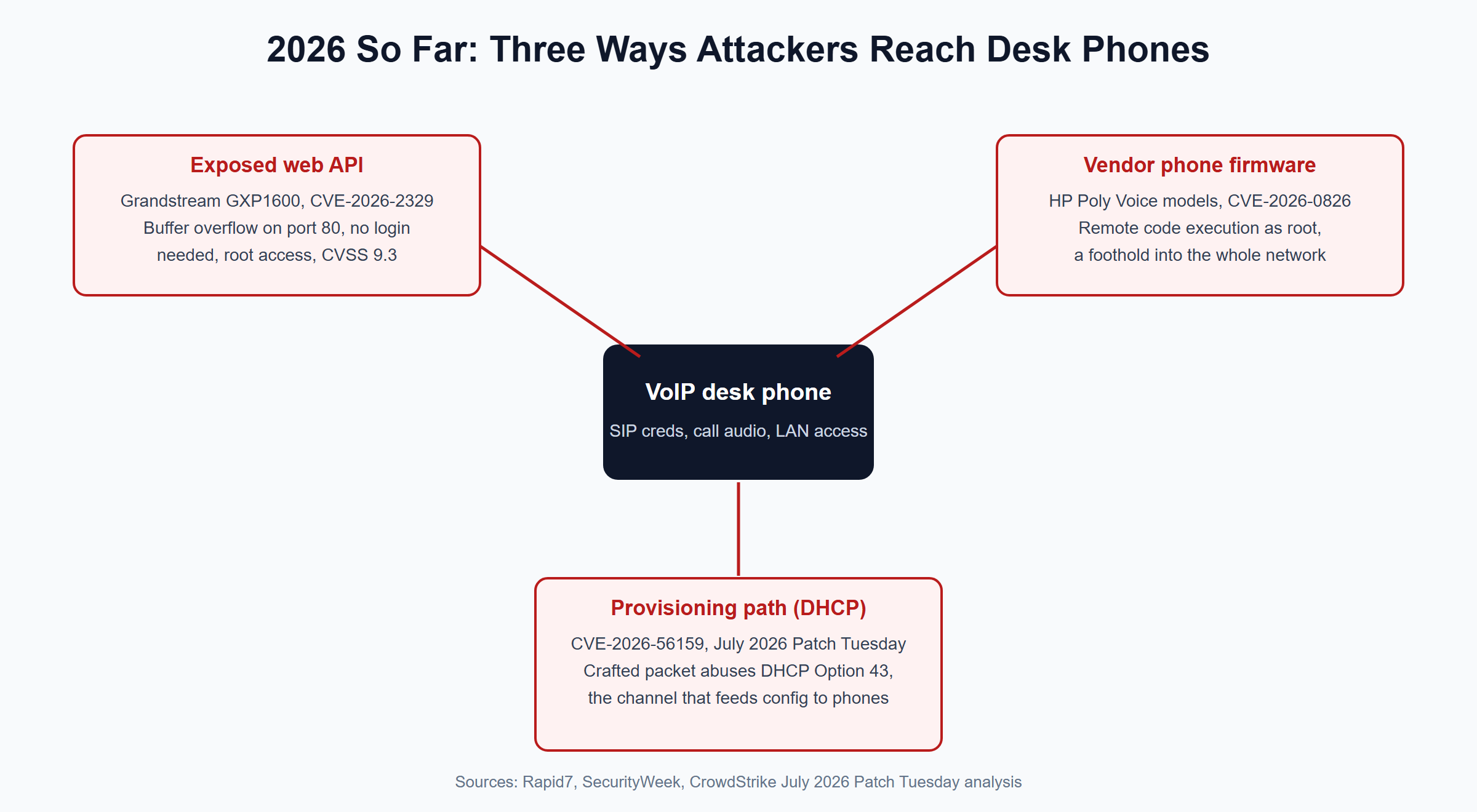
First came the Grandstream GXP1600 flaw, CVE-2026-2329. A stack based buffer overflow in the phone’s web API on port 80 lets an unauthenticated attacker run code as root, rated CVSS 9.3. Public Metasploit modules exist, so exploitation takes one crafted HTTP request. From there an attacker can pull SIP credentials, point the phone at a rogue proxy and quietly record calls.
Then researchers disclosed CVE-2026-0826 in HP Poly Voice phones. Same story, different vendor: remote code execution with root privileges, and a compromised handset becomes a foothold inside the corporate network.
July’s Patch Tuesday added a third path. CVE-2026-56159 can be triggered by a crafted packet aimed at DHCP Option 43, the vendor specific field that many deployments use to hand configuration data to VoIP phones and access points. That one targets the provisioning channel itself, which should worry every service provider.
Why This Is a Service Provider Problem
Desk phones are the least patched devices on any business network. They get installed once, work for years and never appear in the IT team’s update routine. Small businesses running a hosted PBX seat don’t even know what firmware their handsets run.
That makes phone security a platform responsibility. If you operate a white label voice service, your customers assume the phones you shipped or certified are safe. When one gets popped and international toll fraud shows up on an invoice, the dispute lands on your desk, not the customer’s.
Five Controls That Belong in Your Platform
The good news: every effective control sits on infrastructure you already run.
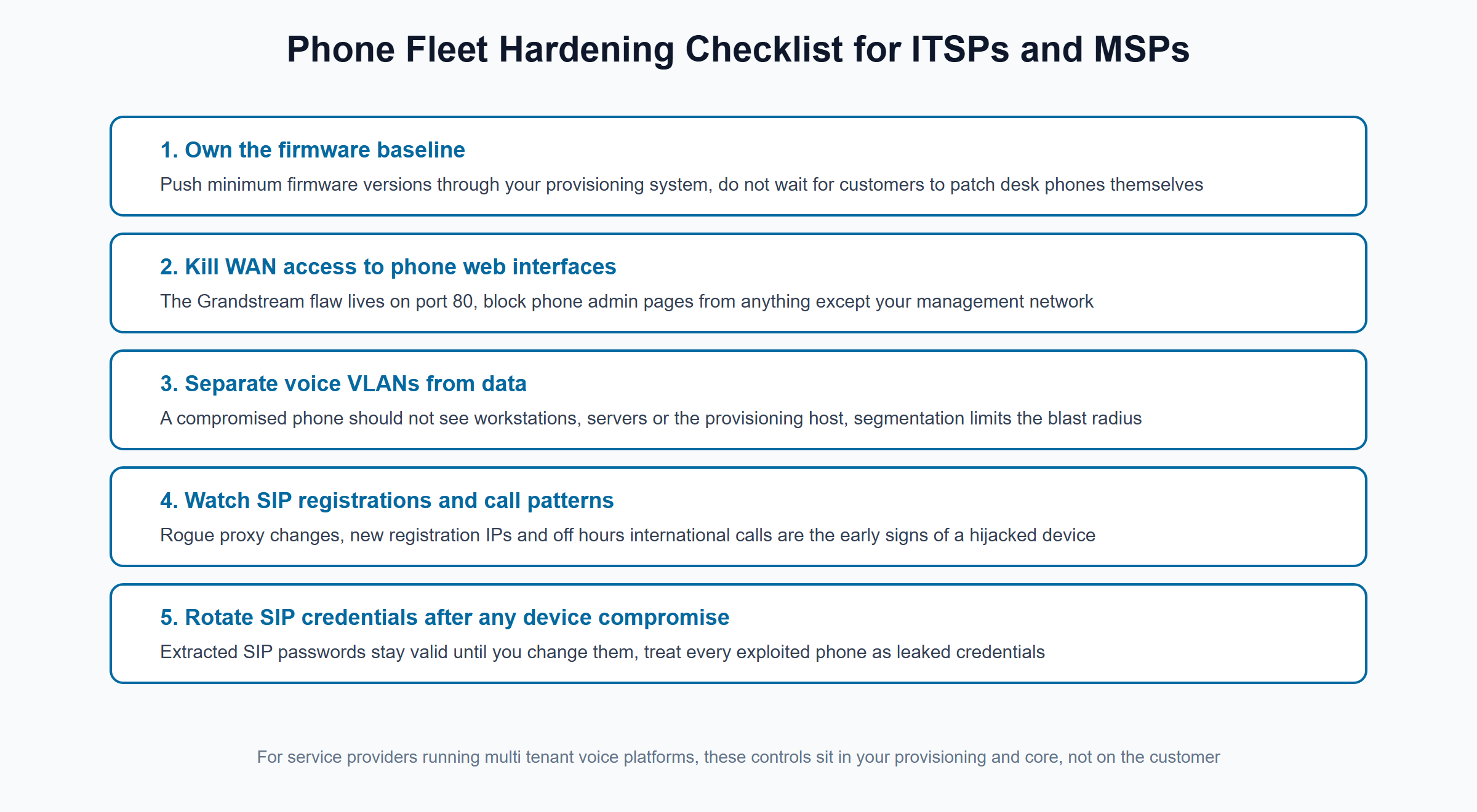
- Own the firmware baseline. Your provisioning server should enforce minimum firmware versions and push updates on schedule. Grandstream patched CVE-2026-2329 in firmware 1.0.7.81, but a fix only counts once it reaches the device.
- Block WAN access to phone web interfaces. The Grandstream exploit needs to reach port 80 on the phone. Deny that from everywhere except your management network and the attack disappears.
- Separate voice VLANs from data. A compromised phone that can only see the SIP trunk can’t pivot to workstations or servers.
- Watch SIP behavior. New registration IPs, proxy changes and off hours international calling are the early signals of a hijacked handset. A multi tenant platform with per tenant call reporting surfaces these fast.
- Rotate SIP credentials after any compromise. Extracted passwords stay valid until you change them. Treat every exploited phone as a credential leak.
Building This Into a White Label Offer
Providers running our ICTPBX white label platform already control provisioning and SIP registration centrally, which is exactly where these defenses belong. The same segmentation and monitoring logic applies to high volume outbound platforms like ICTBroadcast, where stolen SIP credentials translate directly into fraud minutes. And if your service mix includes document delivery, the ICTFax platform keeps that traffic on the same hardened core rather than on forgotten analog adapters.
Security is becoming a selling point in the ITSP market, not a cost line. A provider who can tell prospects how phone fleets get patched, segmented and monitored has an answer competitors mostly lack.
FAQ
Which VoIP phones were affected in 2026?
The headline cases are the Grandstream GXP1600 series (CVE-2026-2329) and multiple HP Poly Voice models (CVE-2026-0826). July’s CVE-2026-56159 affects DHCP based provisioning paths that feed configuration to phones from many vendors.
How urgent is the Grandstream flaw?
Very. It needs no authentication, public exploit code exists, and it grants root access. Any GXP1600 phone below firmware 1.0.7.81 that exposes its web interface should be treated as compromised until patched.
Can attackers really listen to calls through these bugs?
Yes. With root access on a handset an attacker can redirect SIP traffic through a rogue proxy and record conversations, along with extracting stored credentials.
What should an MSP do first for customer fleets?
Inventory phone models and firmware versions, then block phone admin interfaces from anything except the management network. Those two steps remove the most exposed attack surface in an afternoon.
Does a hosted PBX make this easier or harder?
Easier, if the platform controls provisioning. Centralized firmware and configuration management means one fix protects every tenant, instead of thousands of phones waiting for manual updates.
Related Resources
- ICTPBX: White Label Multi Tenant PBX
- ICTBroadcast: Service Provider Auto Dialer
- ICTFax: Fax Over IP Platform
- ICTCore: Communications Framework
Running a voice platform and want a second pair of eyes on your provisioning security? Open a ticket and talk to our engineering team.
