
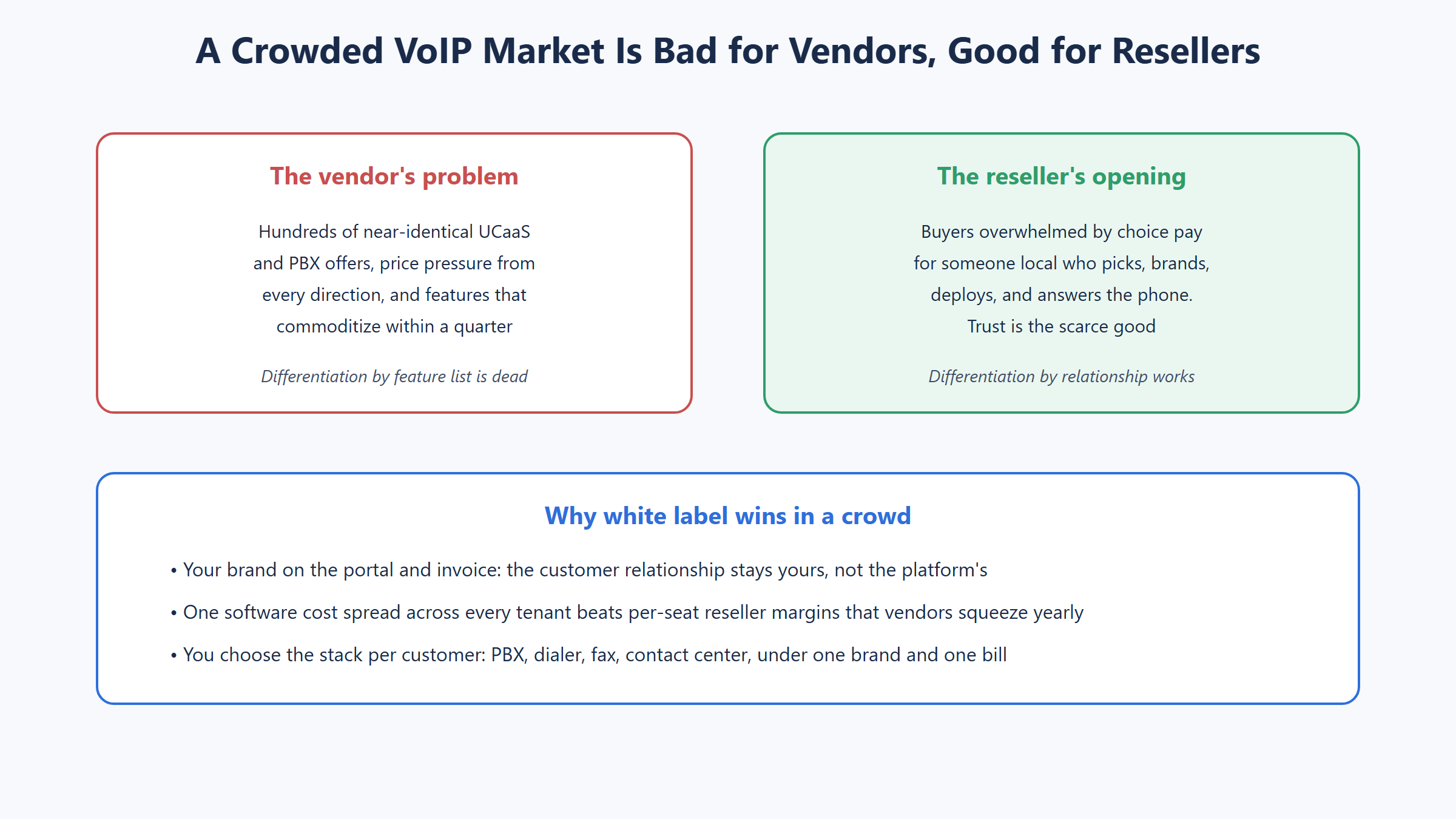
A theme kept surfacing in this month’s telecom trade coverage: the VoIP and UCaaS market has become brutally crowded. Hundreds of providers, near-identical feature lists, and buyers who can’t tell one hosted phone offer from the next. Commentators frame this as bad news. It is, for vendors trying to out-feature each other. For a different player, the local reseller running white-label ICT software under their own brand, a crowded market is the best news in years. Confusion is a product opportunity, and trust is the scarce good.
Why Crowding Kills Feature Competition
When forty providers offer auto attendants, mobile apps, call recording, and now AI answering, the feature list stops being a reason to choose anyone. Features commoditize within a quarter of shipping. Price becomes the only visible difference, and price competition in a commodity market is a race everyone loses slowly.
Buyers respond to this the way people always respond to overwhelming choice: they stop evaluating and start looking for someone to trust. A small business owner comparing their fourteenth hosted PBX tab doesn’t want a fifteenth. They want a person, ideally nearby, ideally recommended, who will pick the right system, install it, brand the invoice clearly, and answer the phone when something breaks.
That person is the reseller. And the reseller’s economics only work if the software underneath carries their brand, not somebody else’s.
The White-Label Difference, in Cold Terms
There are two ways to resell communications services. In the agent model, you sell a big platform’s brand for a commission, and the platform owns the customer, sets the price, and trims your margin whenever its investors need a better quarter. In the white-label model, the platform is invisible: your brand on the portal, your name on the invoice, your relationship, your pricing.
The second model has a structural property that matters more as markets crowd: the customer relationship is an asset you own. When renewal pressure comes, the customer’s loyalty attaches to you, the party who answered the phone at 6 p.m., not to a logo they’ve never seen. In a market where trust is the differentiator, giving the trust away to an upstream brand is giving away the business.
One Brand, a Whole Portfolio
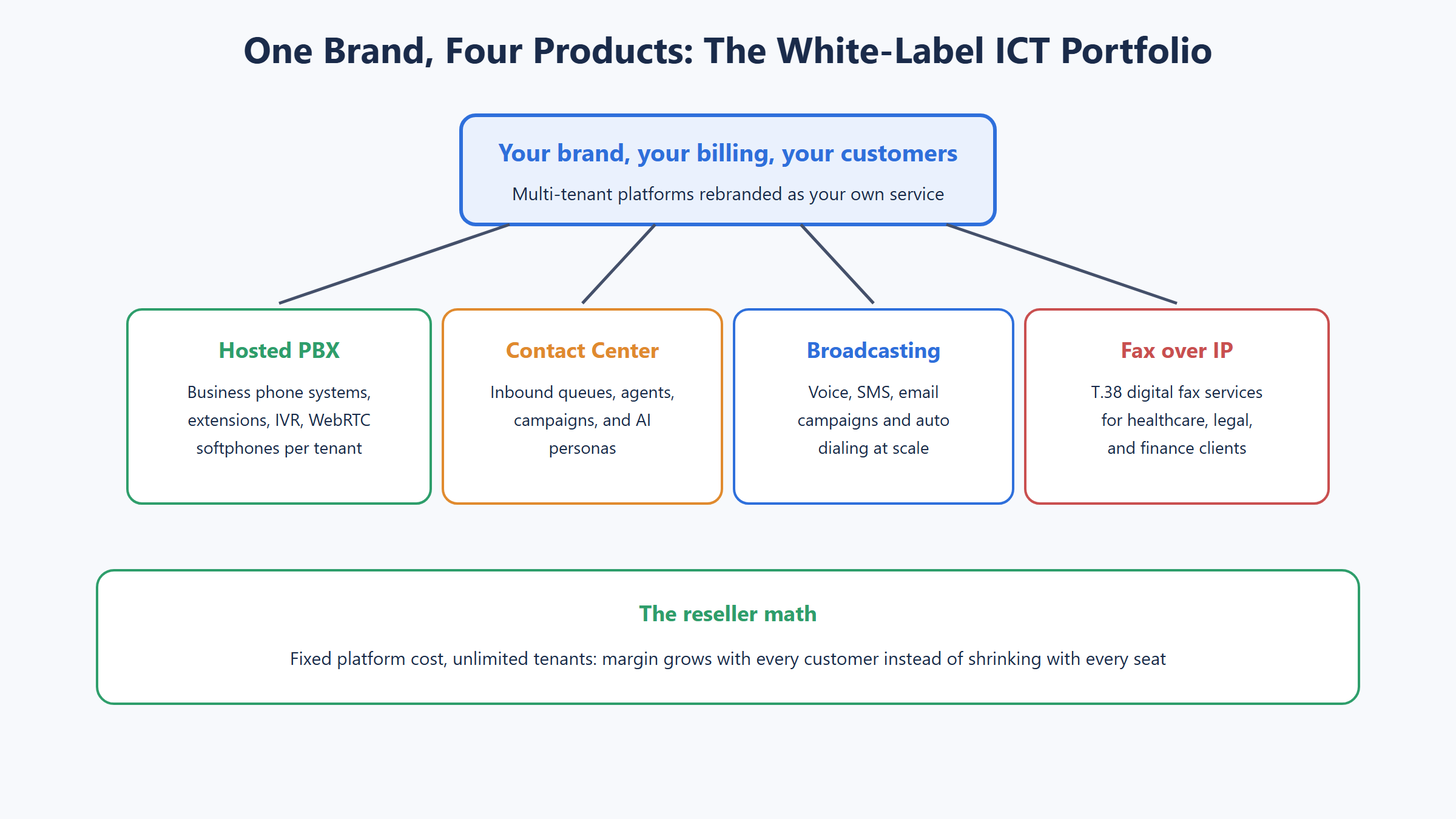
The other advantage crowding hands to resellers is breadth. A vendor fights to win one product category. A reseller with a white-label portfolio sells whatever this particular customer needs: a hosted PBX for the law office, a broadcasting and auto-dialing platform for the collections agency, digital fax over IP for the clinic that lives under compliance rules. Same brand, same bill, same trusted person across all of it.
Multi-tenancy is what makes the math work. These platforms run every customer as a tenant on infrastructure you control, so the software cost is fixed while the tenant count grows. Compare that to per-seat reseller margins, which vendors compress year after year, and the difference compounds: the white-label reseller’s margin grows with each customer added, instead of shrinking with each contract renewal.
My honest advice to anyone weighing this: the hard part isn’t the technology, it’s committing to the service relationship. White-label reselling is a service business wearing a software costume. If you don’t want to answer the 6 p.m. call, stay an agent. If you do, the crowded market is currently manufacturing overwhelmed buyers faster than resellers are absorbing them.
Where ICT Vision Fits
ICT Vision exists for exactly this play: a white-label B2B portfolio, PBX, contact center, broadcasting, fax, CRM, built on ICTCore and delivered multi-tenant so resellers and service providers can launch under their own brand without building a platform first. The crowding that’s making headlines is the demand side of that equation. The supply side is a portfolio, a brand of your own, and the willingness to be the person a confused buyer trusts.
FAQ
What does white label mean in ICT software?
The software runs under your brand: your logo on the portal, your domain, your invoices, your pricing. Customers see your company as the service provider, while the underlying platform stays invisible to them.
Why is a crowded VoIP market good for resellers?
Crowding overwhelms buyers, and overwhelmed buyers stop comparing features and start seeking a trusted local party to choose and manage the service for them. Resellers monetize that trust; vendors competing on feature lists can’t.
What’s the difference between an agent and a white-label reseller?
An agent sells the platform’s brand for a commission and the platform owns the customer. A white-label reseller owns the brand, the pricing, and the customer relationship, and pays for the platform instead of surrendering the relationship to it.
How does multi-tenant software improve reseller margins?
One platform installation serves every customer as a separate tenant, so the software and infrastructure cost stays roughly fixed while revenue scales with tenants. Margin per customer grows as the base grows, unlike per-seat commission models.
What services can a white-label ICT reseller offer?
A typical portfolio covers hosted PBX for business phone systems, contact center software, voice and SMS broadcasting, digital fax for regulated industries, and CRM, all under one brand and one bill.
