
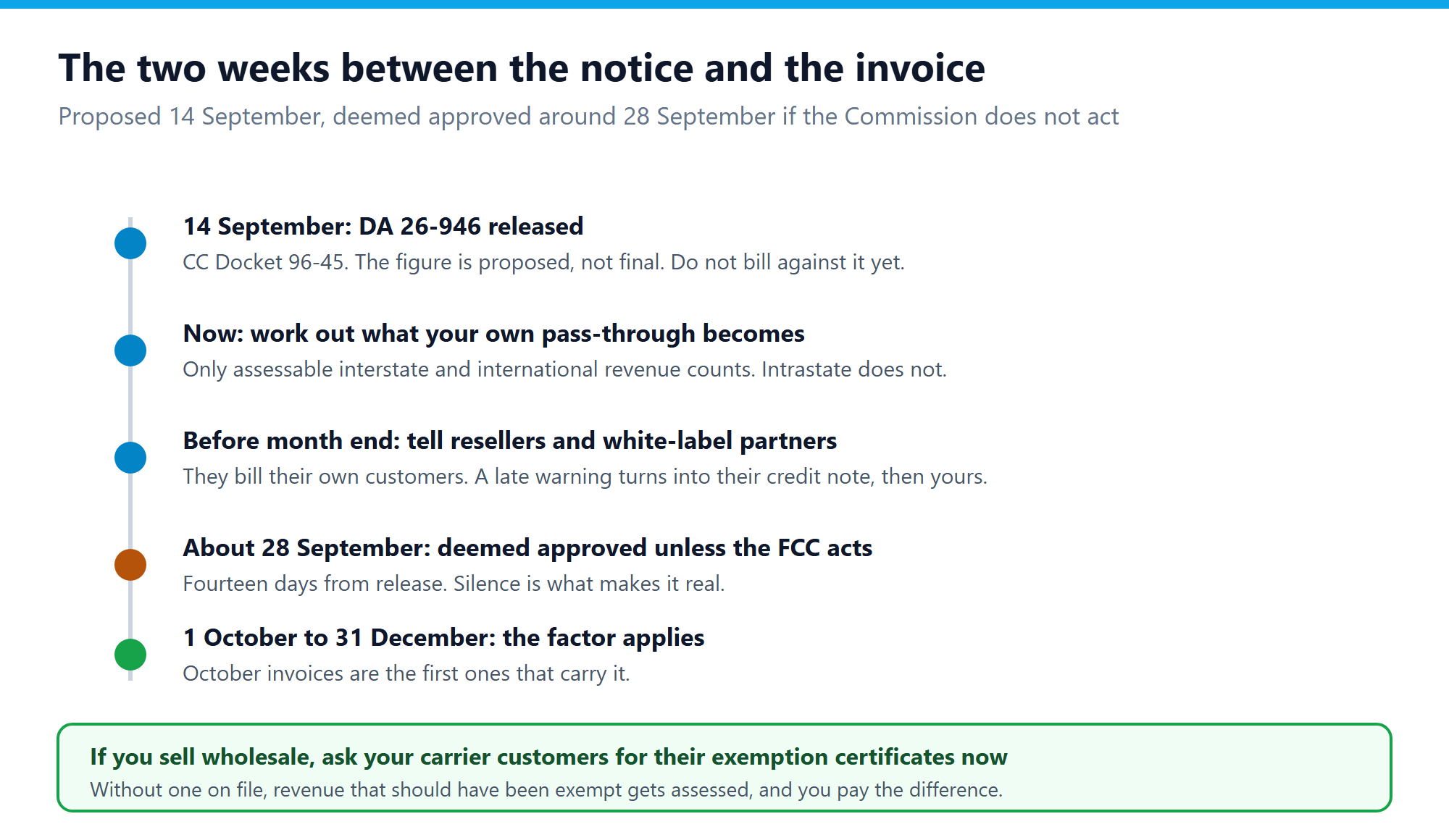
The FCC has proposed a Universal Service Fund contribution factor of 42.0% for the fourth quarter of 2026, up from 38.8% in Q3. That is a record high for the second quarter running. It was released on 14 September in Public Notice DA 26-946 under CC Docket No. 96-45, and unless the Commission acts within fourteen days it is deemed approved. Your October invoices carry it.
What the number actually is
The contribution factor is the percentage of your assessable interstate and international end user revenue that goes to the Universal Service Fund. At 42%, every assessable dollar owes 42 cents. Intrastate revenue is not assessable, which is why two providers with identical turnover can owe very different amounts.
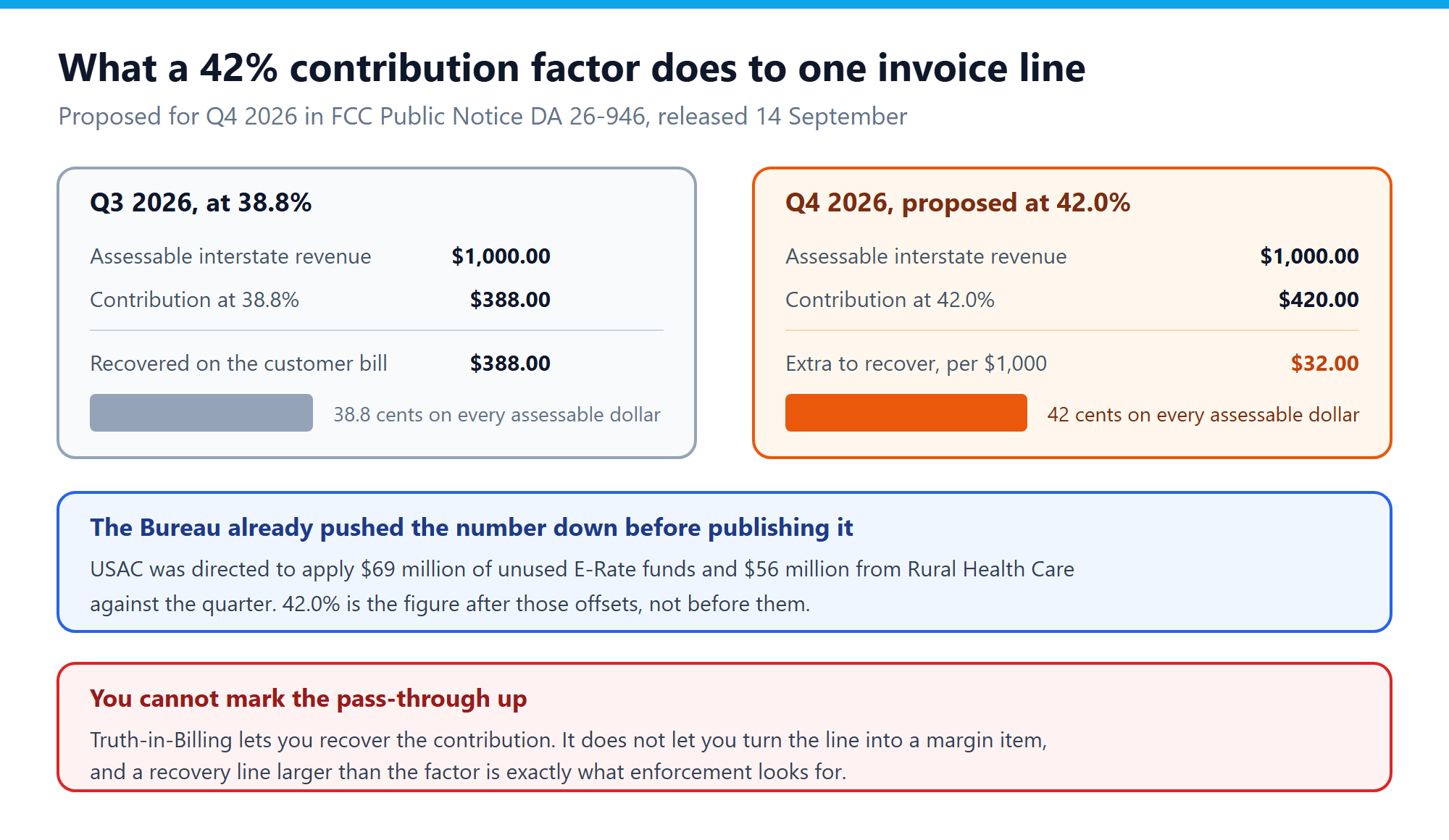
On a thousand dollars of assessable revenue the quarter-on-quarter move is 32 dollars. That sounds small until you multiply it by a book of business and remember it lands on one line of every affected bill, in a quarter you have probably already quoted.
The figure is after the offsets, not before them
Here is the part that gets missed. The Office of Managing Director directed USAC to apply $69 million of unused E-Rate funds and $56 million from Rural Health Care against the quarter. 42.0% is what came out the other side. Without those the proposed factor would have been higher still.
That matters for planning, because one-off offsets are exactly that. You cannot build a 2027 forecast on the assumption that unused money will keep showing up to soften the number.
Why this lands harder on wholesale and white-label
If you sell direct, you reprice one set of invoices. If you run a wholesale or white label platform, the change has to travel. Your resellers bill their own customers under their own brand, on their own cycles, often with their own billing systems. They cannot pass through what they have not been told about.
The failure mode is predictable. A partner bills October at the old rate, notices in November, and then has to decide between eating the difference or sending a correction to customers who thought the price was settled. Either way it becomes a support conversation, and eventually it becomes your support conversation.
You can recover it. You cannot mark it up
Truth-in-Billing lets you recover your contribution from customers as a separate line. It does not let you treat that line as a margin opportunity. A recovery charge noticeably larger than the factor applied to the assessable portion of the bill is one of the clearest things an enforcement review can spot, because anyone can do the arithmetic from a copy of the invoice.
Two related habits are worth checking while you are in there. Label the line so it is obviously a regulatory recovery rather than a government-mandated tax, and apply the factor only to the assessable portion rather than to the whole bill.
The exemption certificates nobody chases until it hurts
Selling wholesale to another carrier is generally not assessable at your level, because they contribute on the retail revenue instead. That relief depends on having their exemption certificate on file. No certificate, and the revenue is treated as assessable at your end, which means you pay a contribution you already priced away.
At 42% the cost of a missing certificate is materially higher than it was two quarters ago. Now is a sensible time to go through the file and find the gaps, rather than discovering them during a true-up.
One more thing on the calendar
Separately, comments on the FCC’s proposed Robocall Mitigation Scorecard are due on 22 September, with replies on 2 October, under DA 26-932 in CG Docket No. 26-239. The proposal scores retail voice providers and, as drafted, leaves pure wholesale and intermediate providers out of the scoring. If you sit in that middle layer, the scope language is worth reading closely rather than assuming it does not apply to you.
What to do this week
Work out your own pass-through at 42% on assessable revenue only. Tell your resellers and platform partners in writing, with the date the change applies and the wording you would like on the line item. Check that your billing platform lets you change the factor per quarter without a code release, because it will change again in January. And pull the exemption certificates.
None of this is difficult. It is just time-sensitive, and the window between a public notice and a billing run is shorter than it looks.
Frequently asked questions
Is the 42% figure final?
No. It is proposed. Under the standing process it is deemed approved if the Commission does not act within fourteen days of release, which puts the effective date around 28 September for a quarter starting 1 October. Treat it as the planning number and confirm before you bill.
Which revenue is assessable?
Interstate and international end user telecommunications revenue. Intrastate revenue is not. Getting the split right matters more at 42% than it did at 30%, and a jurisdictional allocation that was roughly right a few years ago is worth revisiting.
Do resellers contribute directly?
It depends on who reports the retail revenue. Where the underlying carrier contributes on that revenue, the reseller generally does not contribute again on the same dollars, which is what the exemption certificate documents. Without the certificate the carrier has to assess it.
Can we just absorb the increase instead of passing it through?
You can. Plenty of providers do on competitive accounts. The obligation to contribute sits with you either way, so absorbing it is a margin decision rather than a compliance one.
How much notice do our partners need?
More than you think, because their billing cycles are not yours. Anything that has to reach an end customer before 1 October needs to be with the partner in September, not on the first working day of the quarter.
