
The FCC votes on 19 November 2026 on new rules for VoIP providers that get US phone numbers directly. If adopted, providers with direct access would have to certify they aren’t on the FCC’s Covered List and don’t run covered equipment. The draft also asks whether to make them list affiliates that resell those numbers. If you run a white-label voice business, your number supply is in scope even if you’ve never filed with the FCC yourself.
Most white-label providers never deal with the FCC’s numbering rules directly. They buy DIDs from a carrier or wholesaler, put them on their own platform and sell the service under their own brand. That’s exactly the layer this proceeding is working its way down to. Here’s what the draft order does, what it only asks about, and what’s worth getting in order before your upstream asks.
What’s on the table for 19 November
Chairman Brendan Carr announced the item on 28 October, calling it a way to strengthen “our first line of defense against bad actors and illegal robocallers.” The public draft, FCC-CIRC2611-03, was posted on 29 October in WC Docket Nos. 13-97, 07-243 and 20-67. It’s a draft, so the text can still change before or at the vote.
The draft has two parts. The Fourth Report and Order would adopt rules. The Fourth Further Notice of Proposed Rulemaking would only ask questions. Keeping the two apart matters, because a lot of the coverage you’ll read this month blurs them.
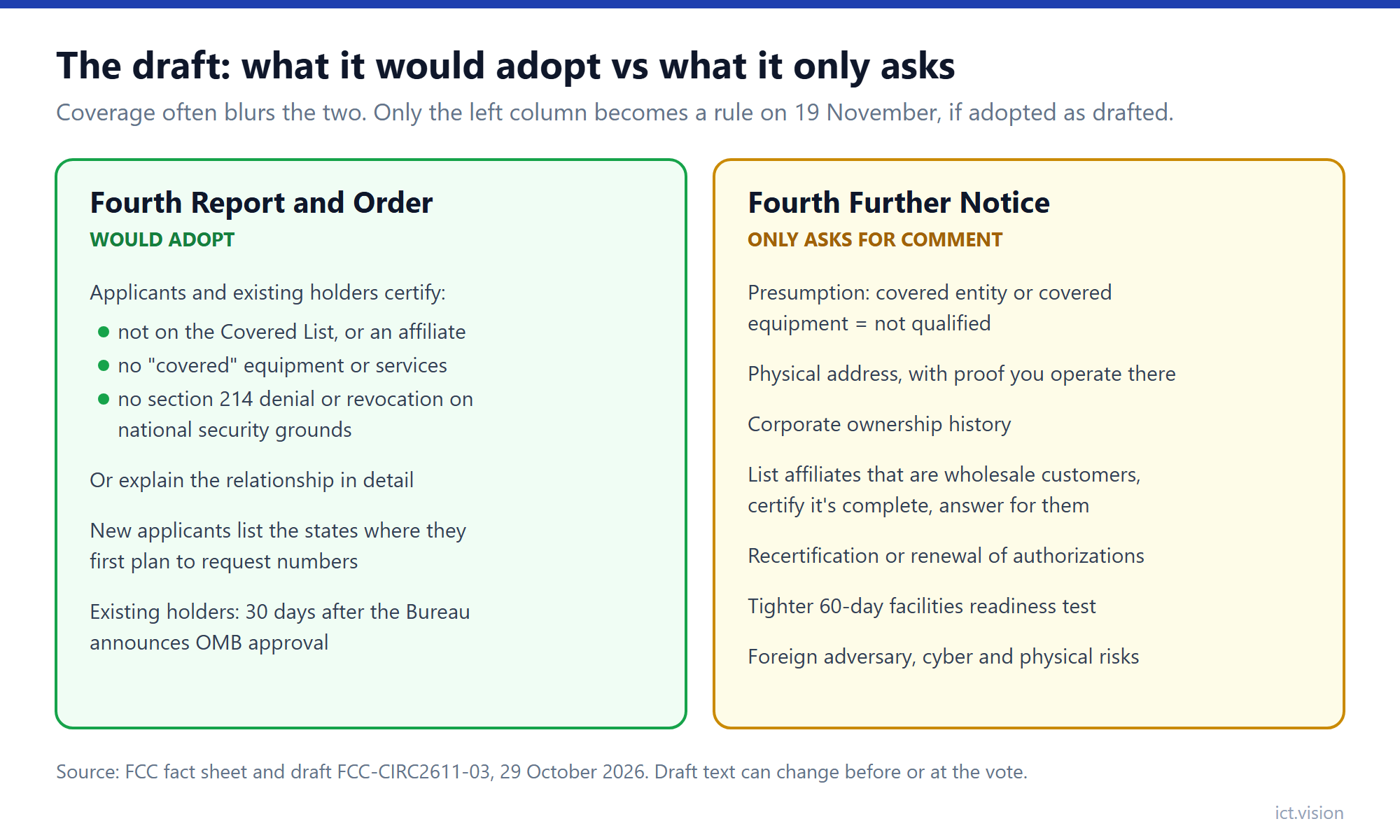
What the order would require. New applicants for a VoIP numbering authorization, and providers that already hold one, would have to:
- Certify that they aren’t an entity on the FCC’s Covered List, or an affiliate or subsidiary of one, or explain the relationship in detail.
- Certify that their networks don’t use “covered” communications equipment or services, or explain how they do.
- Certify that they haven’t had a section 214 authorization denied or revoked on national security or law enforcement grounds, and aren’t affiliated with anyone who has.
New applicants would also list the US states where they first plan to request numbers. Existing holders and pending applicants would have 30 days to comply once the Wireline Competition Bureau announces approval of the new information collection by the Office of Management and Budget. So the clock doesn’t start on 19 November; it starts later, with that announcement.
What the FCC is only asking about
The Further Notice is where white-label providers should pay the most attention, because several of its questions reach past the direct access holder. The draft seeks comment on:
- A presumption against covered entities. Any applicant that certifies it’s on the Covered List, or that its network uses covered equipment, would be presumed not qualified to hold a numbering authorization.
- A physical address. Applicants and existing holders might have to disclose one and show they actually operate from it.
- Ownership history. A corporate ownership history disclosure.
- Affiliates that resell the numbers. Holders could be asked to list every affiliate that is or will be a direct or indirect wholesale customer, certify the list is complete, and accept compliance responsibility for those entities. The alternative it floats is requiring each affiliate that uses the numbers to get its own authorization.
- Recertification or renewal. Whether authorizations should be recertified at intervals or renewed, rather than granted once.
- Facilities readiness. Whether the rule that a provider must be able to serve customers within 60 days of number activation needs tightening.
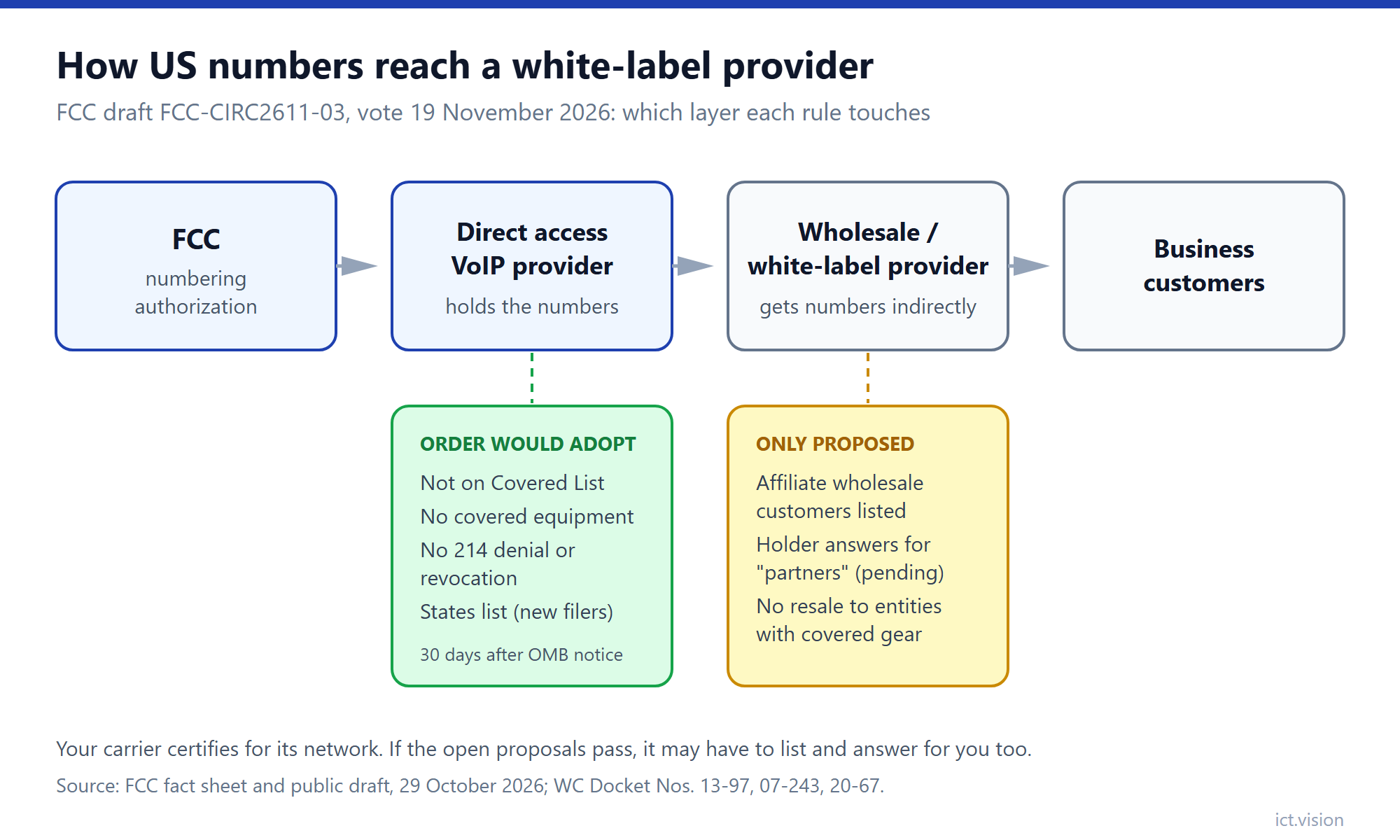
Two older questions stay open as well, and they’re the ones aimed most squarely at resellers. One, first raised in the Second Further Notice, is whether direct access holders should be held accountable for the “partners” that get numbers through them. The other, from the 2025 Third Further Notice, is whether holders should be barred from serving entities with covered equipment, so that equipment can’t reach numbers indirectly through resale. The draft says it doesn’t decide either, and both remain pending. Carr’s announcement also points back to a March 2026 proposal to extend certification and disclosure requirements to every provider that gets numbers, directly or indirectly.
Why this reaches white-label providers
The order itself binds direct access holders. But those holders are your suppliers, and suppliers pass obligations down. When a carrier has to certify what’s in its own network, it starts asking what’s in yours. When it may have to list its wholesale customers and answer for them, it starts vetting those customers harder.
We’ve seen the same pattern on the UK side. When Ofcom fined Tismi for numbers it sub-allocated without proper checks, the lesson for white-label providers holding sub-allocated numbers was that the upstream’s controls become your onboarding questionnaire. The US is heading the same way, more slowly.
Five things to have ready before your carrier asks
- Know your number path. Write down where every block of numbers you use comes from, and whether that supplier holds its own direct access authorization or buys from someone who does.
- Keep an equipment list. List the switches, session border controllers, phones and gateways in your call path, with the manufacturer of each. If anything on it comes from a company named on the Covered List, such as Huawei or ZTE, you’ll want to know before a supplier’s certification does it for you.
- Have a real address and an ownership chart. Both are cheap to prepare now and awkward to assemble under a deadline.
- Keep records of who uses your numbers. Which customer holds which DID, since when, and for what kind of traffic. It’s what a supplier will ask for if it has to answer for its wholesale customers.
- Watch the vote and the comment dates. If the item is adopted on 19 November, comment deadlines on the Further Notice will follow its publication in the Federal Register. That’s your chance to say how affiliate lists or recertification would work for a small provider.
Running your platform on your own servers helps here. When the PBX, contact center and SBC are yours, you can answer the equipment question line by line instead of asking a hosted vendor for a statement. ICT Vision’s white-label platforms are installed on your own servers, and you bring your own carrier and SIP trunk, so you know what sits in your call path. See the platforms and one-time licence prices. For the other cost line US voice providers are watching this quarter, read our note on the Q4 2026 USF contribution factor.
Frequently asked questions
What is the FCC voting on on 19 November 2026?
A Fourth Report and Order and Fourth Further Notice of Proposed Rulemaking on VoIP numbering, public draft FCC-CIRC2611-03 in WC Docket Nos. 13-97, 07-243 and 20-67. The order would add national security certifications for providers with direct access to US numbers; the Further Notice asks about more disclosures and checks.
Does this apply to white-label VoIP providers?
The order applies to providers that hold, or apply for, a VoIP numbering authorization. Most white-label providers get numbers from a carrier instead, so they aren’t bound directly. They’re likely to feel it through their suppliers, and several open proposals would reach indirect users of numbers.
What certifications would direct access holders have to make?
That they aren’t on the FCC’s Covered List or affiliated with an entity on it, that their networks don’t use covered equipment or services, and that they haven’t had a section 214 authorization denied or revoked on national security or law enforcement grounds. Where they can’t certify, they’d have to explain in detail.
When would the new requirements take effect?
If adopted, existing authorization holders and pending applicants would have 30 days to comply after the Wireline Competition Bureau announces approval of the information collection by the Office of Management and Budget. That announcement would come after the vote.
What is the FCC’s Covered List?
It’s the FCC’s list of communications equipment and services found to pose an unacceptable risk to US national security. It names companies such as Huawei and ZTE, and the draft would tie number access to certifications about it.
